
Antibiotica-geassocieerde diarree: weten hoe te voorkomen
Waarom kunnen antibiotica diarree veroorzaken?
Antibiotica zijn essentieel voor de behandeling van bacteriële infecties.²,³ maar ze richten zich niet alleen op de bacteriën die de infectie veroorzaken: ze kunnen ook de goede bacteriën in je darmen verstoren.¹
Dit kwetsbare evenwicht, de darmmicrobiota genoemd, speelt een sleutelrol bij de spijsvertering, de opname van voedingsstoffen en de afweer, en biedt bescherming tegen schadelijke ziektekiemen. ¹,⁵
De darmmicrobiota is een levend en dynamisch ecosysteem dat snel kan veranderen onder invloed van talrijke factoren, zoals het gebruik van antibiotica.²⁰
Antibiotica worden in verband gebracht met een verstoring van de diversiteit van de darmmicrobiota en een afname van de afweer in de darmen, wat de stimulering van de ontwikkeling van de ziekteverwekkende bacteriën kan bevorderen en diarree kan veroorzaken.¹,⁴
Wist u dat?
Diarree is een vaak voorkomende bijwerking van antibiotica die plots optreedt, maar kan ook verband houden met meer ingrijpende veranderingen in het darmmicrobioom die de ontwikkeling van pathogene darmbacteriën kunnen stimuleren.⁴
Hoe u uw darmen kunt beschermen tijdens een antibioticabehandeling
Probiotica kunnen helpen het risico op antibiotica-geassocieerde diarree te verminderen door het evenwicht van de darmbacteriën tijdens de behandeling te ondersteunen.⁶⁻⁸
Probiotica worden gedefinieerd als “levende micro-organismen die, wanneer zij in adequate hoeveelheden worden toegediend, een gezondheidsvoordeel opleveren voor de gastheer”.⁹
Van bepaalde probiotische stammen is aangetoond dat ze kunnen helpen bij het aanpakken van darmproblemen zoals diarree, waaronder diarree in verband met antibioticagebruik.⁸,¹⁰ Door het door antibiotica verstoorde darmmicrobioom te helpen herstellen, ondersteunen probiotica het herstel van de darm.¹¹⁻¹³
Om uw darmmicrobiota te beschermen tijdens het gebruik van antibiotica, is het raadzaam om voor een probioticum te kiezen dat niet door deze geneesmiddelen wordt vernietigd.
Lees meer over probiotica en hun rol bij de aanpak van diarree.
Enterol®: een probiotische geneesmiddel
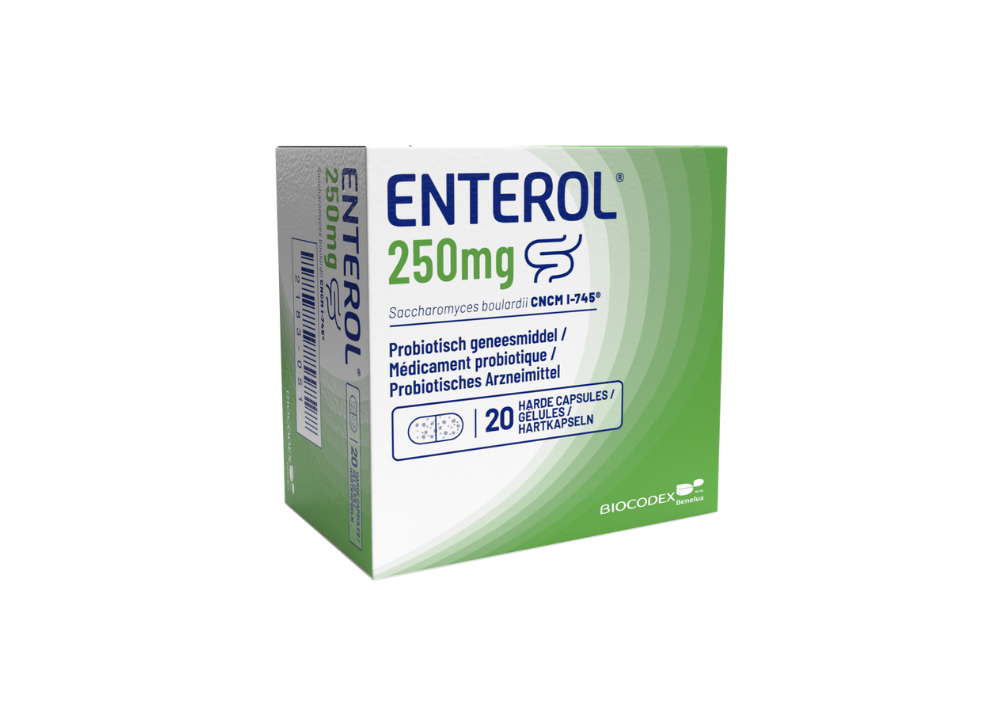
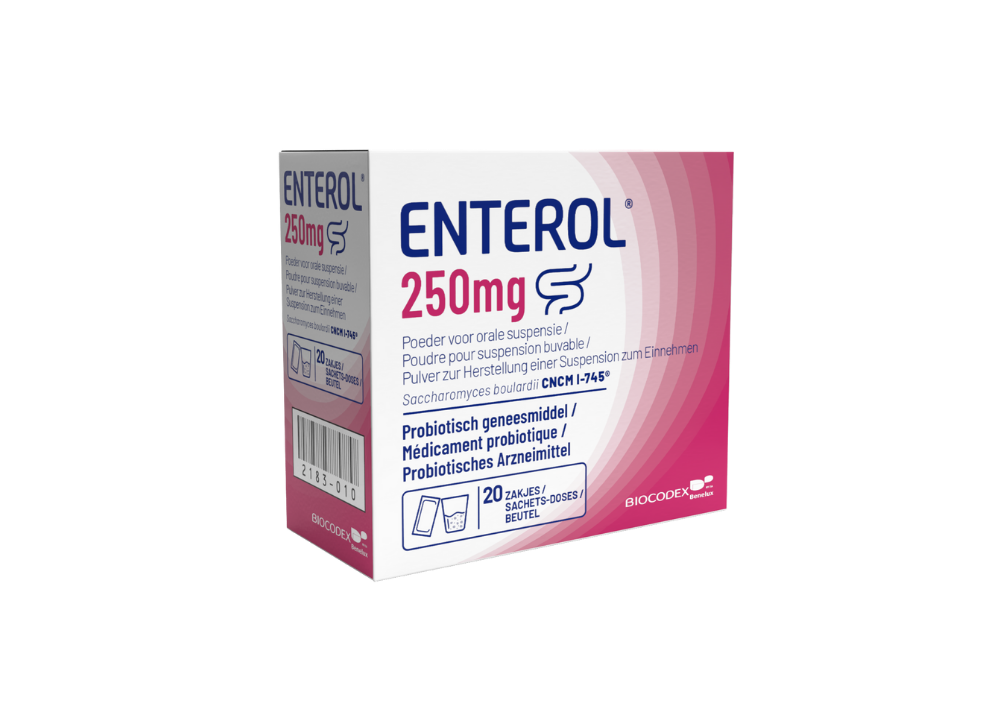
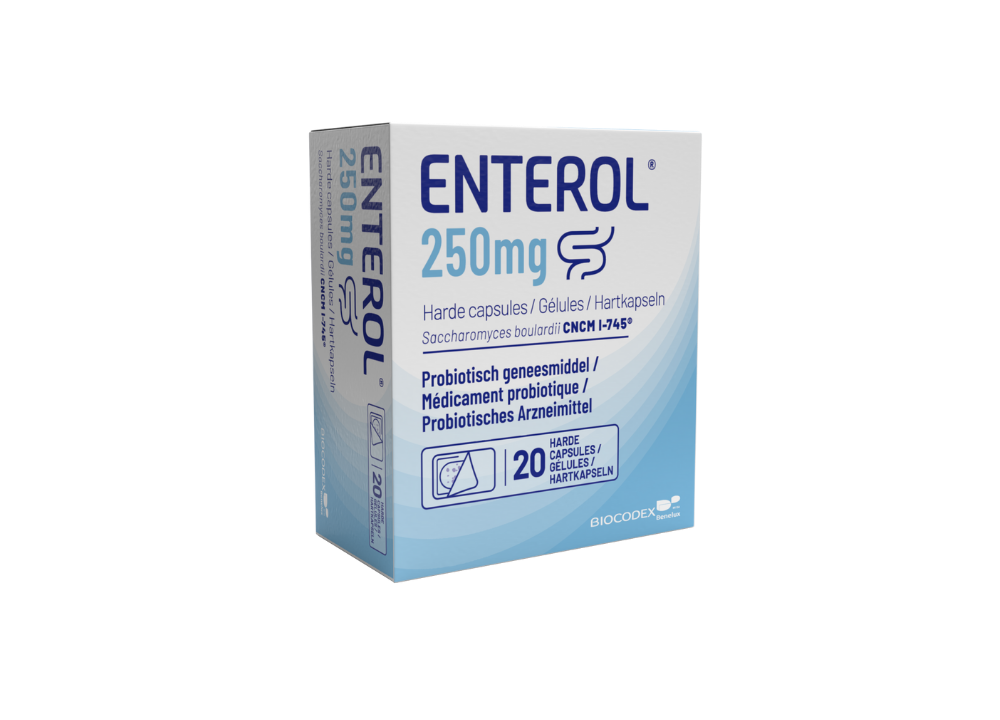
Enterol® is een probiotisch geneesmiddel op basis van Saccharomyces boulardii CNCM I-745, geïndiceerd voor de preventie van antibiotica-gerelateerde diarree bij mensen die gevoelig zijn voor het ontwikkelen van Clostridium difficile diarree of herval van Clostridium difficile diarree.
- Enterol® voorkomt diarree ten gevolge van antibiotica met respect voor het evenwicht in uw darmen.
- Enterol® beschermt en verlaagt de ongewenste effecten van antibiotica, vermindert het risico op antibiotica-gerelateerde diarree en versnelt het herstel ervan.⁴,¹⁵
- Enterol® wordt niet vernietigd door antibiotica en kan tijdens de behandeling worden ingenomen.¹⁶,¹⁷
S. boulardii CNCM I-745® is een probiotische gistsoort waarover klinische studies zijn uitgevoerd, met een bewezen werkzaamheid bij diarree als gevolg van een antibioticabehandeling.¹⁸,¹⁹
 S. boulardii CNCM I-745® wordt bovendien in Frankrijk geproduceerd via een uniek productieproces²¹
.png)
Onze expertise
Enterol® is niet alleen geschikt voor antibiotica-geassocieerde diarree. Ontdek alle indicaties.
Ontdek het assortiment probiotische geneesmiddelen Enterol®
De unieke probiotische gist van Enterol® de belangrijkste aandoeningen van de darmflora behandelt dankzij wetenschap, innovatie en klinische resultaten.
1. Ramirez J, et al. Antibiotics as Major Disruptors of Gut Microbiota. Front Cell Infect Microbiol. 2020;10:572912. 2020 doi:10.3389/fcimb.2020.572912
2. McFarland LV, Ozen M, Dinleyici EC et al. Comparison of pediatric and adult antibiotic-associated diarrhea and Clostridium difficile infections. World J Gastroenterol. 2016;22(11):3078-3104. doi: 10.3748/wjg.v22.i11.3078
3. Ianiro G, Tilg H, Gasbarrini A. Antibiotics as deep modulators of gut microbiota: between good and evil. Gut. 2016;65:1906–1915. doi: 10.1136/gutjnl-2016-312297
4. Guarner F, Bustos Fernandez L, Cruchet S, et al. Gut dysbiosis mediates the association between antibiotic exposure and chronic disease. Front Med. 2024;11:1477882. doi:10.3389/fmed.2024.1477882
5. Jandhyala SM, Talukdar R, Subramanyam C, et al. Role of the normal gut microbiota. World J Gastroenterol. 2015;21(29):8787–8803. doi:10.3748/wjg.v21.i29.8787
6. Kabbani TA, Pallav K, Dowd SE, et al. Prospective Randomized Controlled Study on the Effects of Saccharomyces Boulardii CNCM I-745 and Amoxicillin-Clavulanate or the Combination on the Gut Microbiota of Healthy Volunteers. Gut Microbes. 2017;8(1):17–32. doi:10.1080/19490976.2016.1267890.
7. Waitzberg D, Guarner F, Hojsak I, et al. Can the Evidence-Based Use of Probiotics (Notably Saccharomyces boulardii CNCM I-745 and Lactobacillus rhamnosus GG) Mitigate the Clinical Effects of Antibiotic-Associated Dysbiosis? Advances in Therapy. 2024;41(3):901–914. doi: 10.1007/s12325-024-02783-3.
8. Williams NT. Probiotics. AJHP. 2010;67(6):449–458. doi:10.2146/ajhp090168.
9. Hill C, et al. The International Scientific Association for Probiotics and Prebiotics consensus statement on the scope and appropriate use of the term probiotic. Nat Rev Gastroenterol Hepatol. 2014;11(8):506-14. doi: 10.1038/nrgastro.2014.66
10. Guarner F, Sanders ME, Szajewska H, et al. World Gastroenterology Organization Global Guidelines. Available at: https://www.worldgastroenterology.org/guidelines/probiotics-and-prebiotics/probiotics-and-prebiotics-english, last accessed 3, Sep, 2025.
11. Hori T, Matsuda K, Oishi K. Probiotics: A Dietary Factor to Modulate the Gut Microbiome, Host Immune System, and Gut–Brain Interaction. Microorganisms. 2020;8(9):1401. https://doi.org/10.3390/microorganisms8091401.
12. Maftei NM, Raileanu CR, Balta AA, et al. The Potential Impact of Probiotics on Human Health: An Update on Their Health-Promoting Properties. Microorganisms. 2024;12(2):234. doi:10.3390/microorganisms12020234.
13. Latif A, Shehzad A, Niazi S, et al. Probiotics: mechanism of action, health benefits and their application in food industries. Frontiers Microbiol. 2023;14:1216674. doi:10.3389/fmicb.2023.1216674.
14. Swidsinski A., et al., Functional anatomy of the colonic bioreactor: Impact of antibiotics and Saccharomyces boulardii on bacterial composition in human fecal cylinders Syst Appl Microbiol 39(2016) 67- 75
15. Hempel S et al. Probiotics for the prevention and treatment of antibiotic associated diarrhea: a systematic review and metaanalysis. Jama 2012; 307(18): 1959-69. Doi: 10.1001/jama.2012.3507
16. Neut C, Mahieux S, Dubreuil LJ. Antibiotic susceptibility of probiotic strains: Is it reasonable to combine probiotics with antibiotics?. Med Mal Infect. 2017;47(7):477-483. doi:10.1016/j.medmal.2017.07.001
17. Kazmierczak-Siedlecka K, Ruszkowski J, Fic M, et al. Saccharomyces boulardii CNCM I-745: A Non-bacterial Microorganism Used as Probiotic Agent in Supporting Treatment of Selected Diseases. Curr Microbiol. 2020;77(9):1987-1996. doi:10.1007/s00284-020-02053-9
18. Martins FS, Vieira AT, Elian SD, et al. Inhibition of tissue inflammation and bacterial translocation as one of the protective mechanisms of Saccharomyces boulardii against Salmonella infection in mice. Microbes Infect. 2013;15(4):270-279. doi:10.1016/j.micinf.2012.12.007
19. Pubmed 30/03/2026, keyword «boulardii»; type «clinical trial», excluding animal studies, including clinical trials not appearing in «clinical trial» tag- Kelly 2019, Cardenas 2020, Wang 2019, Zhao 2021
20. The nutrition source. (2022, 25 juillet). The microbiome. https://www.hsph.harvard.edu/nutritionsource/microbiome/
21. Receipt of the deposit to the National Collection of Microorganism Cultures, Institut Pasteur.