
Wat zijn probiotica?


Wat zijn probiotica en hoe kunnen ze helpen?
Probiotica worden gedefinieerd als ‘levende micro-organismen die, wanneer ze in de juiste hoeveelheden worden ingenomen, gezondheidsvoordelen kunnen bieden’.² Hoewel elke probiotische stam anders werkt, is van sommige aangetoond dat ze helpen bij bepaalde darmklachten, waaronder diarree (zoals door infectie veroorzaakte diarree of reizigersdiarree), prikkelbare darmsyndroom (IBS), lactose-intolerantie en inflammatoire darmziekten (IBD's).²⁻⁶
Probiotica kunnen bijdragen aan het behoud van een evenwichtige darmflora en de barrièrefunctie van de darmen ondersteunen.⁷⁻⁹ Ze spelen ook een rol bij de manier waarop het lichaam voedsel verwerkt, ondersteunen het immuunsysteem en helpen bij het reguleren van belangrijke signalen die van invloed zijn op de algehele gezondheid.⁷⁻⁹
Een veilig en effectief probioticum kiezen
Niet alle probiotica zijn hetzelfde, omdat verschillende stammen werkzaam zijn voor verschillende gezondheidsbehoeften.¹⁰ Daarom is het belangrijk om de informatie op het productetiket te controleren, zoals de specifieke stam, de dosering en de formulering, om er zeker van te zijn dat deze aansluiten bij wat u zoekt.¹¹
Probiotische producten moeten bovendien worden onderbouwd door solide klinisch bewijs.¹¹⁻¹³ Dit betekent dat de stam, de soort, de dosering en de formulering die in het product worden gebruikt, identiek moeten zijn aan die welke in wetenschappelijke studies doeltreffend zijn gebleken.¹⁰⁻¹²
Resultaten die met één stam zijn verkregen, kunnen niet worden geëxtrapoleerd naar een andere stam, zelfs niet als deze op elkaar lijken.
Uw darmmicrobioom speelt een belangrijke rol in uw algehele gezondheid. Met het juiste probioticum kunt u helpen het evenwicht te herstellen.
Waarom probiotica nemen tijdens een antibioticabehandeling?
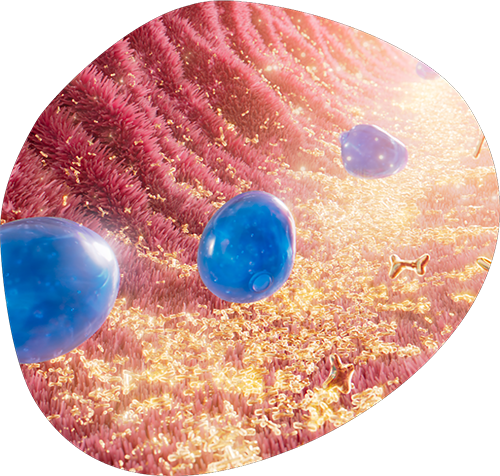
Antibiotica zijn essentieel voor de behandeling van bacteriële infecties en redden levens, maar ze kunnen ook het darmmicrobioom verstoren.¹⁴ Deze verstoring vermindert het vermogen van de darm om het lichaam te beschermen en kan zowel op korte als op lange termijn gevolgen hebben.²,¹⁴⁻¹⁶
Op korte termijn, dit kan onder meer leiden tot een verhoogd risico op overgroei van schadelijke bacteriën, antibiotica-geassocieerde diarree (die tot 35% van de patiënten kan treffen) en zelfs tot de ontwikkeling van resistente bacteriën.¹⁴,¹⁷ Langetermijneffecten kunnen bestaan uit een verhoogd risico op aandoeningen zoals astma, andere immuun- of ontstekingsstoornissen en zelfs angstklachten.²,¹⁵
Het innemen van probiotica kan helpen bij het herstel van het darmmicrobioom tijdens en na een antibioticabehandeling.⁶
Gistgebaseerde probiotica bieden daarbij bepaalde voordelen ten opzichte van bacteriële stammen.¹⁸ Omdat ze van nature resistent zijn tegen antibiotica, blijven ze actief gedurende de volledige behandeling.¹⁸
Daarnaast helpen gistprobiotica de darmbarrière te versterken en de immuunafweer te ondersteunen, zonder door het antibioticum zelf te worden aangetast of vernietigd.¹⁸,¹⁹
Probiotica & acute diarree
Een verminderde diversiteit van de darmmicrobiota wordt in verband gebracht met een verhoogde gevoeligheid voor diarree. Het behoud van een evenwichtige en diverse darmmicrobiota kan daarom diarree voorkomen en de spijsvertering bevorderen.²¹
- Een evenwichtige darmmicrobiota beschermt uw darmen: wanneer de microbiota in evenwicht is (dit wordt ‘eubiose’ genoemd), helpt ze infecties te voorkomen. Bij een verstoring van het evenwicht (‘dysbiose’) neemt het risico op diarree toe.
- De darmmicrobiota fungeert als een natuurlijke barrière: ze beperkt de vestiging van ziekteverwekkende indringers die infecties veroorzaken door met hen te concurreren.
- De darmmicrobiota helpt bij een goede vertering en opname van water: de goede bacteriën produceren stoffen (korteketenvetzuren) die de darm voeden, de opname van water verbeteren en bijdragen aan een normale stoelgang
- De darmmicrobiota speelt een sleutelrol in de immuniteit: een verstoorde darmmicrobiota kan de immuunrespons ontregelen, ontstekingen en het ontstaan van diarree bevorderen
- Diarree verstoort de darmmicrobiota sterk: tijdens een episode van diarree nemen de goede bacteriën af en krijgen bepaalde minder gunstige bacteriën de overhand. Dit verzwakt de darmbarrière.
Bij de behandeling van acute diarree moet rekening worden gehouden met de verstoring van de darmmicrobiota.
Dit artikel is uitsluitend bedoeld ter informatie en voor educatieve doeleinden. Het is geen vervanging voor professioneel medisch advies en vormt geen promotionele inhoud of reclame voor enig product.
Gerelateerde inhoud

1. Sniffen JC, McFarland LV, Evans CT, et al. Choosing an appropriate probiotic product for your patient: An evidence-based practical guide. PLOS One. 2018;13(12):e0209205. doi:10.1371/journal.pone.0209205.
2. Waitzberg D, Guarner F, Hojsak I, et al. Can the Evidence-Based Use of Probiotics (Notably Saccharomyces boulardii CNCM I-745 and Lactobacillus rhamnosus GG) Mitigate the Clinical Effects of Antibiotic-Associated Dysbiosis? Advances in Therapy. 2024;41(3):901–914. doi: 10.1007/s12325-024-02783-3.
3. Williams NT. Probiotics. American Journal of Health-System Pharmacy. 2010;67(6):449–458. doi:10.2146/ajhp090168.
4. Binns, N. ILSI Europe Concise Monograph 2013:1–32. Available at: https://ilsi.org/europe/wpcontent/uploads/sites/3/2016/05/Prebiotics-Probiotics.pdf, last accessed 3 Oct 2025.
5. McFarland LV. Meta-analysis of probiotics for the prevention of traveler's diarrhea. Travel Medicine and Infectious Disease. 2007;5(2):97–105. doi:10.1016/j.tmaid.2005.10.003.
6. Guarner F, Sanders ME, Szajewska H, et al. World Gastroenterology Organization Global Guidelines. Available at: https://www.worldgastroenterology.org/guidelines/probiotics-andprebiotics/probiotics-and-prebiotics-english, last accessed 3, Sep, 2025.
7. Hori T, Matsuda K, Oishi K. Probiotics: A Dietary Factor to Modulate the Gut Microbiome, Host Immune System, and Gut–Brain Interaction. Microorganisms. 2020;8(9):1401. https://doi.org/10.3390/microorganisms8091401.
8. Maftei NM, Raileanu CR, Balta AA, et al. The Potential Impact of Probiotics on Human Health: An Update on Their Health-Promoting Properties. Microorganisms. 2024;12(2):234. doi:10.3390/microorganisms12020234.
9. Latif A, Shehzad A, Niazi S, et al. Probiotics: mechanism of action, health benefits and their application in food industries. Frontiers in Microbiology. 2023;14:1216674. doi:10.3389/fmicb.2023.1216674.
10. Sanders ME, Merenstein DJ, Reid G, et al. Probiotics and prebiotics in intestinal health and disease: from biology to the clinic. Nature Reviews Gastroenterology & Hepatology. 2019;16(10):605–616. doi:10.1038/s41575-019-0173-3.
11. Merenstein DJ, Sanders ME, Tancredi DJ. Probiotics as a Tx resource in primary care. The Journal of Family Practice. 2020;69(3):E1–E10.
12. Binda S, Hill C, Johansen E, et al. Criteria to Qualify Microorganisms as "Probiotic" in Foods and Dietary Supplements. Frontiers in Microbiology. 2020;11:1662. doi:10.3389/fmicb.2020.01662.
13. ISAPP. International Scientific Association for Probiotics and Prebiotics. Available at: https://isappscience.org/wp-content/uploads/2019/04/Probiotic-Checklist-Infographic.pdf, last accessed 3 October 2025.
14. Guarner F, Bustos Fernandez L, Cruchet S, et al. Gut dysbiosis mediates the association between antibiotic exposure and chronic disease. Frontiers in Medicine. 2024;11:1477882. doi:10.3389/fmed.2024.1477882.
15. Levy M, Kolodziejczyk AA, Thaiss CA, et al. Dysbiosis and the immune system. Nature Reviews Immunology. 2017;17(4):219–232. doi:10.1038/nri.2017.7.
16. Francino MP. Antibiotics and the Human Gut Microbiome: Dysbioses and Accumulation of Resistances. Frontiers in Microbiology. 2016;6:1543. doi:10.3389/fmicb.2015.01543.
17. McFarland LV, Ozen M, Dinleyici EC, et al. Comparison of pediatric and adult antibiotic-associated diarrhea and Clostridium difficile infections. World Journal of Gastroenterology. 2016;22(11):3078-3104. doi:10.3748/wjg.v22.i11.3078.
18. Puri AS. The Role of Yeast Probiotics in Gastrointestinal Conditions: An Overview. Journal of the Association of Physicians of India. 2023;71(4):11-12. doi:10.5005/japi-11001-0235.
19. Neut C, Mahieux S, Dubreuil LJ. Antibiotic susceptibility of probiotic strains: Is it reasonable to combine probiotics with antibiotics?. Médecine et Maladies Infectieuses. 2017;47(7):477-483. doi:10.1016/j.medmal.2017.07.001.
20. Moré MI, Swidsinski A. Saccharomyces boulardii CNCM I-745 supports regeneration of the intestinal microbiota after diarrheic dysbiosis - a review. A review. Clinical and Experimental Gastroenterology. 2015 Aug 14;8:237-55. doi: 10.2147/CEG.S85574. PMID: 26316791; PMCID: PMC4542552.
22. Cruchet et al 2025 - IBAM-LASPGHAN guidelines probiotics